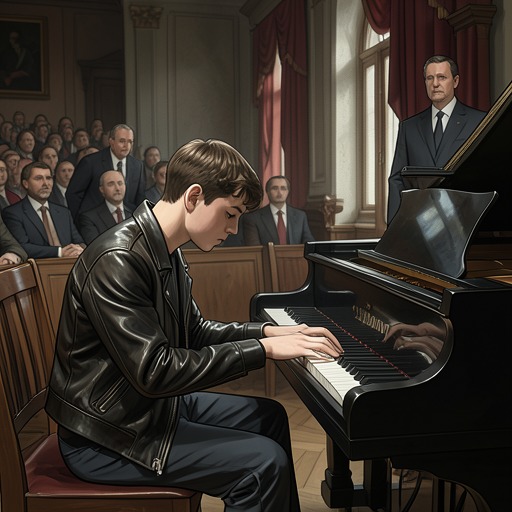
Rikaishi piano
Big BrotherThe upright piano Pandora rents for Edison is deliberately ordinary, but its role in their shared life is anything but incidental. Intended as a way for him to recover the pleasure of playing without the pressure of professional achievement, it becomes a private practice, a source of companionship during their liquid diet, and the setting for a recognition that Pandora has recovered the brother she remembers.
A deliberately ungrand instrument
Pandora rents the upright piano after concluding that Edison’s recovery must include something beyond weight loss and survival. She suspects he has lost touch with the exhilaration of playing simply for its own sake, so she chooses an instrument whose mediocre character is meant to keep the undertaking casual. The choice defines the piano’s purpose: it is not a vehicle for a comeback, a public performance, or proof of talent, but an invitation to make music without turning it into another test.
The piano arrives while the siblings are living together and following an all-liquid diet. Pandora arranges for Novacek to let the movers in, and the instrument is placed at a right angle to the scale. That juxtaposition makes the apartment’s two kinds of work visible: the scale registers bodily change, while the piano offers an activity not measured by pounds. Edison’s first reaction is worry rather than delight. He says he is rusty and approaches the keyboard cautiously, answering Pandora’s encouragement with a minor, somewhat complicated chord whose anguish he lets linger.
Music without a comeback
Pandora explicitly separates playing from professional ambition. She tells Edison not to practice in order to rebuild his technique or plan a return to the stage in New York; she cannot promise that he will again become an internationally renowned jazz pianist. What she can offer is the possibility that music itself, and the pleasure of playing it, remain available. The piano thus changes the scale of his ambition: its value lies in the act, not in recognition or a restored career.
At first Edison will touch the keys only when Pandora is out, so she invents errands to give him privacy. About ten days later, she returns from coffee with Tanner and finds him playing “Bridge Over Troubled Water.” She asks him not to stop, and this time he continues. The change is small but consequential: the instrument has moved from a solitary, guarded encounter toward music that can be heard and shared.
The piano also gives the household a new rhythm during the diet. Pandora observes that playing is more involving than television, and Edison begins to turn to the keyboard after work as he once turned to the pantry. His reflective improvisations bring life into an apartment emptied of the ordinary sounds and smells of meals: groceries no longer slam onto the counter, silverware no longer clatters, and pies no longer scent the air. The piano does not replace food as a bodily necessity; it gives Edison an absorbing practice that can occupy some of the time and attention once organized around eating.
As he becomes more assured, his playing grows lighter and less confined to the jazz identity that had defined him. He moves among ragtime, old pop songs such as Elton John’s “Tiny Dancer,” David Bowie’s “Starman,” and medleys of Queen, R.E.M., and Billy Joel; he also takes requests for songs by Crosby, Stills, and Nash, James Taylor, and Carole King, as well as show tunes from Chess and Sweeney Todd. This breadth matters because the piano allows him to expand beyond a narrow professional niche without requiring him to abandon music. Pandora, whose own appreciation of jazz has grown, is relieved to hear a wider range of familiar material.
Lessons and a changing household
Cody begins visiting for piano lessons, giving her time with her uncle a welcome structure. The teaching becomes reciprocal: Edison introduces her to Thelonious Monk, while Cody introduces him to Lyle Lovett. Their exchange makes the piano a shared object of attention rather than merely a tool for Edison’s solitary recovery. It also gives Cody a reason to visit when the family’s diet leaves Pandora able to offer little more than diet soda.
The absence of meals changes the texture of those evenings. Without hospitality’s customary food and small talk, the visits can feel stark, but they also become more emotionally direct. Cody talks about uncertainty over choosing a career, eating disorders among her classmates, and her humiliation at being assigned to a social-skills class because she is considered withdrawn. The lessons do not solve those problems, but the piano provides a regular occasion for conversation in which they can surface. Its domestic usefulness therefore extends beyond music: it helps turn visits that might otherwise remain socially thin into encounters with greater candor.
Recognition in the spring light
The most intimate scene associated with the piano occurs one late Saturday afternoon in March. Pandora has gone to Hy-Vee for toilet paper and tea; Edison stays home and plays. When she returns, warmer spring sunlight falls through the blinds across his head. The light reveals the high cheekbones that once defined his face, a feature Pandora associates with the older brother she remembered from Tujunga Hills. Since he arrived at Cedar Rapids Airport, his face had changed so much that she had trained herself to recognize a different-looking person who happened to have the same unusual name.
Seeing his cheekbones and familiar features in the light, Pandora exclaims that she sees him. Edison looks up from a chord in one of Cody’s favorite songs, “Quitting Time” by the Roches, and answers uncertainly that he is glad he is still three-dimensional. Pandora comes behind him and hugs him, registering his firmer shoulders as a physical reminder of earlier memories. She recognizes that her effort to help him was not motivated only by concern about diabetes: she wanted her big brother back. The piano does not itself account for his weight loss, but it supplies the scene in which music, the changed body, and Pandora’s renewed recognition meet.
Significance
The upright piano stands apart from the scale beside which it is placed. Both belong to the siblings’ effort to change their lives, but they offer different measures of progress: the scale records a numerical verdict, while the piano makes room for attention, pleasure, and imperfect beginnings. Its deliberately unremarkable quality resists the idea that Edison’s recovery must culminate in a spectacular return to fame. He can play while rusty, privately at first, and eventually across styles that are not limited to jazz.
The instrument also gives the household a form of sustenance that is neither food nor a substitute meal. During a period when eating is governed by strict restriction, music occupies Edison after work, animates the apartment, and makes room for Cody’s lessons and confidences. Its significance is consequently relational as well as personal: through the piano, Edison’s brotherhood with Pandora becomes visible in a new way, and his connection with Cody becomes more reciprocal. The return that matters most is not to a stage in New York, but to playing, to family, and to a face Pandora can recognize as her brother’s again.